The Prop Table Is Not a Store Cupboard
A prop table works best when each object has a clear job. Learn how to choose, organise and remove stage props for a village production.
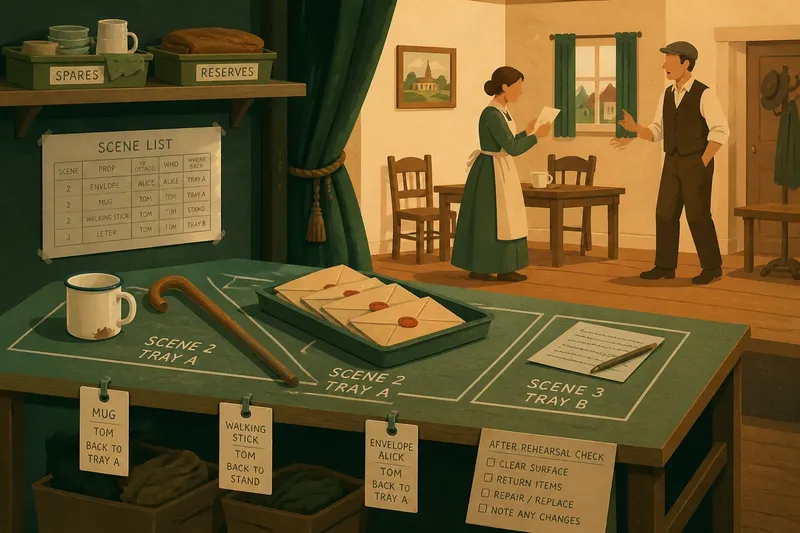
On a village hall stage, a walking stick, a chipped mug and three unopened envelopes can all look useful on the prop table. The question is not whether they belong to the period or the room, but what an actor needs each one to do. A prop table is not a store cupboard: it is a working station for the objects that make the action legible.
What does each prop need to do?
Start with the script and the movement of the scene, not with the jumble of things available in the committee room. A prop can carry information, prompt an action, mark a relationship or help establish a place. If it does none of these jobs, it may be decoration rather than a working prop, and decoration has to earn its space too.
Read the relevant scene aloud and mark the moments when an object is mentioned, picked up, passed, put down or used. Then ask what the audience must understand at each moment. A letter might reveal that news has arrived; the envelope itself is only useful if its handling makes that arrival clear.
- Action: Does the actor need to open, pour, carry, exchange or conceal it?
- Information: Must the audience recognise a particular object or understand what it represents?
- Character: Does the object show a habit, a preference or a connection between people?
- Continuity: Does it need to be in the same place, or in the same condition, when the scene returns to it?
These questions keep a prop tied to playable action. They also make it easier to explain why one object should be kept and another left in the box. An attractive object is not automatically a useful one, and a plain one can be essential if the scene turns on it.
How do you tell a prop from set dressing?
A prop is normally handled or relied on by an actor. Set dressing gives the space its visual character without needing to be manipulated during the action. A tablecloth, a framed photograph and a row of books may dress a parlour. A book the actor reads aloud, a photograph they turn face down or a cloth used to wrap a parcel has a specific prop job.
The distinction is practical, not absolute. An object can be dressing in one scene and a prop in another. Make a note of the change, so nobody removes it as clutter or assumes it will remain untouched. If an object is visible but never handled, decide whether the audience needs it for the setting. If not, removing it can make the important action easier to see.
Keep special attention on objects close to the actors’ hands. A crowded table can create uncertain business: performers may reach for the wrong cup, block a meaningful item or spend a pause fussing with something the script never asks them to use. Clear space is part of the scene’s design.
How should the prop table work?
Give every working prop a repeatable home. On a small stage, this may be a trestle table behind a wing, a labelled tray on a shelf or a marked corner of the green room. The location matters less than the shared understanding that an object returns to its place after use.
Group items by scene or by the person who carries them, whichever matches the production’s traffic. Put a clear label beside each place, and use a simple scene list to record who brings an item on, who handles it and where it goes afterwards. In a village hall, where entrances may be through narrow doors and the backstage area doubles as a changing space, this small map prevents last-minute searching.
Keep the table itself selective. Do not use it as a holding bay for spare crockery, costume accessories or objects that might be useful later. Store reserves separately and label them as spares. A performer should be able to glance at the working layout and identify the object they need without sorting through unrelated belongings.
Check the surface after each rehearsal. Remove cups that have been put down but are not part of the scene, return borrowed items to the right place, and note anything that needs repair or replacement. The check is not a ritual for its own sake; it keeps the next run from inheriting a mystery.
Which details deserve rehearsal time?
Rehearse the handover and the return, not only the spoken line around them. An object’s journey can be the beat that makes a scene clear: a key changes hands, a parcel is refused, a chair is moved to make room. Agree on the exact point at which the action happens, then repeat it consistently.
Weight, sound and grip matter when they affect performance. A metal tray may ring against a wooden table; a full-looking jug may be awkward to lift; a paper envelope may be too stiff to open quietly. Choose materials that suit the action and the venue. If the audience must hear a small sound, make sure the room and the performers’ movement allow it to register without forcing the gesture.
For a simple worked example, imagine a village comedy in which a character claims to have received a telegram. The starting point is a line that mentions the message but no physical exchange. The director and props lead decide that the character will unfold a clearly marked envelope, read from it and hide it when another character enters. They add one envelope and rehearse those actions at the cue; the expected visible result is that the audience can follow the arrival, reading and concealment without extra business.
That does not mean every spoken reference needs a matching object. If the telegram can be understood from the dialogue and a physical envelope would distract from a sharper exchange, leave it out. The useful question is whether the object makes the action clearer or more playable.
What should you ask before adding an object?
Does the script require it?
Look for an action or detail that depends on the object, not just a passing mention. If an actor must use it to complete a beat, it belongs on the working list; if not, consider whether the reference is enough.
Can the audience read its purpose?
A prop should be visible or audible where the story needs it to be. If its meaning depends on tiny print or a detail hidden from the seats, simplify the cue or choose a more legible object.
Can the actor handle it comfortably?
Try the action in the actual space and costume, paying attention to grip, noise and where the object goes next. If handling it interrupts the scene, alter the object or the business rather than adding more items to compensate.
Who returns it after the scene?
Name the person responsible for the reset and identify the object’s place. If no one can answer, the prop is likely to be misplaced between performances or left where the next scene cannot use it.
What is not worth the effort?
Do not collect a shelf of period objects just because the play is set in an earlier time. A few carefully chosen details may suggest the setting; an assortment of unrelated antiques can make the playing area harder to read. Likewise, there is little value in ageing, polishing or labelling an object that the audience cannot see and the actors never use.
Avoid making every pause into business. A character does not need to straighten a stack of papers, stir a cup or inspect a vase simply because those things are nearby. Stillness can carry intention. Add an action only when it clarifies the character’s choice, gives a scene a necessary rhythm or supports the story.
For a rural theatre production, the prop table is best understood as a compact map of actions, not a display of everything the group owns. Keep the objects that help performers tell the story, give each one a known place, and let the rest remain in storage. When a prop has a clear job, the audience can follow what matters without being asked to notice everything else.